
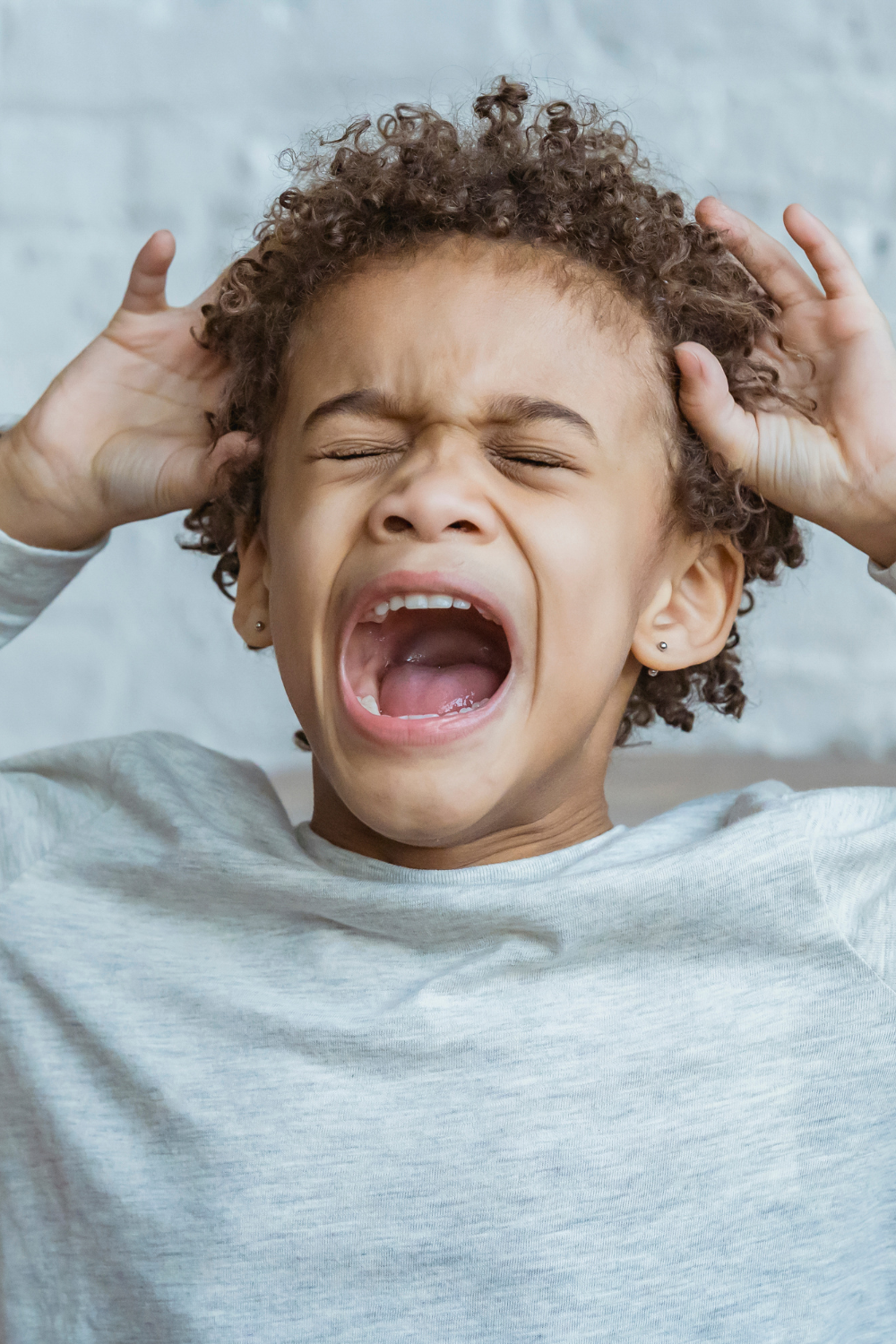
Behavior is communication. Have you heard this saying? We are here to take a quick look at behavior and reasons why parents often see behavior. This post will just scratch the surface on behavior. We will follow up with Part 2 next week, where you will find practical solutions for behavior.
This post contains Affiliate Links. If you make a purchase using the links, we may earn a small commission, with no additional charge to you. Please read our full Affiliate Disclosures statement.
Hi, Chelsea here. I have been a pediatric speech-language pathologist (fancy name for a speech therapist) since 2015. As a newer professional I used to be terrified of “behavior” and therefore I used a pretty straightforward, no nonsense approach to eliminate behaviors. What I wish I would have known then is that behavior is communication and it was my job to navigate it not eliminate it. I cannot wait to share what I have learned with you!
What is Behavior
There are many definitions out there, but I found this one from Oxford Languages, and I think it is perfect to share here.
Behavior: “the way in which an animal or person acts in response to a particular situation or stimulus.”
This goes right along with the “ABCs” of behavior. I clearly remember learning this in a behavioral psychology course while I was in my undergraduate program, many years ago, and this model is still widely used and accepted:
A: Antecedent (also known as triggers)
B: Behavior
C: Consequence
Something happens (Antecedent) = Person responds (Behavior) = The result (Consequence)
If we think about it… behavior is happening all day long. Everyone has “behavior.” We have routines we follow each day; habits; and responses to things, both big and small, positive and negative, or neutral.
From our behavior results a consequence. Also big and small, positive and negative, or neutral. Most people often think of consequences as negative outcomes, but a consequence is truly the result of something. Positive or negative.
Now that we have a basic understanding of behavior, we will apply it to children from my lens as a speech-language pathologist.
Why Do Children Have Behavior
I would say, one of the most common concerns I hear from parents is their child’s behavior. I often hear questions about why their child acts in a particular way.
As I listen to parents’ concerns, I follow-up with a lot of questions. This can often frustrate parents… because they want an answer or a solution not a 100-question quiz. But, what I am trying to do is understand the behavior. I have to understand the antecedent (trigger) as well as the consequence(s) in order to sort out the behavior.
I need to understand what led up to and what followed the behavior and if this is a typical response from the child or a non-typical response from the child. Determining if the behavior happens often or not and/or the situations in which it happens in, helps me determine the patterns of behavior.
From all of this, I can then put the puzzle pieces together to understand the behavior. Once I understand it, I can then help parents start to understand it as well.
“Right …. But understanding it isn’t fixing it. I want them to stop doing that”.
Yes, I hear you, frustrated parent. I see the struggles you are experiencing and I can only imagine how frustrating said behavior is. But, if we jump to a “quick fix” we are going to regret it later. We must first understand, then work with the child to address the behavior. Because if not, the behavior will resurface, escalate, or change into something different. This, like almost everything we talk about on this blog, is about the “ounce of prevention is worth a pound of cure” (Benjamin Franklin).
Causes of Behavior
We all have behavior all day long. But, what most people are referring to when they ask about a child’s behavior is negative behavior.
Let’s look at a few reasons children have negative behavior:
- Sensory dysregulation
- Feeling unsafe
- Repeated patterns or rituals of behavior
- Communication breakdown
I will give a short run-down of each. I am only giving my perspective as a SLP. Psychologists, behavioral analysts, occupational therapists, and more also have opinions and perspectives to provide. I am 1 person, from 1 discipline. And while I have worked with a lot of these different professionals and learned a lot from them, I am not the end all be all for information on behavior. Not even close.
Sensory Dysregulation
This is a broad and difficult idea to conceptualize, but basically, the brain has to be able to make sense of the information that is received by the senses. Most of us think of the 5 “typical” senses: hearing, vision, taste, touch, and smell. There are now many more recognized sensory systems, including proprioception, vestibular, and interoception.
Basically, all of the antecedents (triggers) for behavior are sensed by the individual. If the person has difficulty regulating their sensory systems (this affects both children and adults), their sense of the situation may be different than what a regulated person may experience. Therefore, their response (behavior) to the situation may be impacted.
To make this a little more understandable, think of the last time you were hungry. Like, really hungry. And you had to wait in line to get your food. And the cash register quit working, which made it take even longer. And someone cut in line in front of you or asked you a difficult question.
How did you respond?
Chances are you might have said something to the person who cut in line (or maybe not, but you got even more frustrated). Or your response to the difficult question may have been scattered or shallow in detail.
Why?
Because you were dysregulated. You might have been fidgety, irritable, or distracted, to name a few.
Now, if we put this into perspective for children who are frequently dysregulated because of neurodivergence or even just their developing sensory systems, we can more easily understand why they act a particular way.
To learn more about the sensory system and understand dysregulation, a great book is The Out of Syn Child: https://amzn.to/4k9MK9R . This is a very commonly recommended book for parents by professionals.
A Note on Sleep
One major reason why children easily become dysregulated is due to sleep quality. If children are not getting enough sleep, their brains and bodies have to work really hard to keep them awake all day. When they are just trying to stay awake, they are remaining in brainstem mode. Their executive functioning skills, such as attention, organization, and planning are very poor. They can become easily upset and can be difficult to redirect.
Some reasons children may not be getting adequate sleep:
- Lacking consistent routine(s)
- Screens before bedtime or even in their rooms
- Sleep disordered breathing (apnea, open mouth posture, etc.) *more on this in a future series*
- Over scheduling. Check out David Elkind’s book: The Hurried Child: https://amzn.to/49QICYH for more on this. *Probably one of my favorite and most recommended books*
- And many more…
The American Academy of Pediatrics sleep recommendations:
- Infants 12-16 hours
- 1-2 year olds 11-14 hours
- 3-5 year olds 10-13 hours
- 6-12 year olds 9-12 hours
- 13-18 year olds 8-10 hours
Please, make sure your child is getting adequate sleep most of the time. If you are out of routine for a day or two because of pressing issues or exciting activities (e.g. holidays), that is alright. But, try to protect your child’s sleep more often than not.
Safety
Safety can be thought of as security. Children who live in secure homes or environments and who have minimal or no adverse childhood experiences (ACEs), we as outsiders would say should feel generally safe.
And while this is likely true of typically developing children, those with neurodivergence and/or any sort of sensory processing challenges, may perceive “normal” situations as unsafe.
When people feel unsafe, their brain automatically goes into “fight, flight, or freeze” mode- “brainstem mode” mentioned above. Your brainstem will keep you alive, but it cannot reason, plan, organize, or “think” clearly.
If a tiger is chasing you, you perceive danger, you either fight, fly, or freeze. You do not sit down and try to have a conversation with the tiger and plan a way to safety. You react.
When children perceive danger, their bodies go into “brainstem” mode. They can fight the situation. Flight (escape, run). Or Freeze (do nothing). What does this look like? Behavior.
They have a tantrum; they literally try to run or escape or even try to “talk their way out” of a situation; or they avoid the activity.
This is where understanding the behavior is so important. They are not just “acting out”. They are in brainstem mode. They are terrified. They cannot reason, process, or organize a plan. They cannot act rationally. They need taken back to “safety” before they can do any of those things.
Mona Delahooke is one of my favorite authors on this topic. Check out her books for more!
- Beyond Behaviors: https://amzn.to/3Mf33FK
- Brain-Body Parenting: https://amzn.to/3NW9tKj
Repeated Patterns or Rituals of Behavior
Many reading this subheading likely have a picture in their head of repeated patterns or rituals of behavior. Those that are often thought of as “stereotypical” behaviors associated with Autism Spectrum Disorder or Obsessive Compulsive Disorder. And while these are not wrong, I also want to point out that everyone has repeated patterns or rituals of behavior.
Think of your morning routine – do you do the same thing every day? It is pretty likely. And if you get interrupted or miss part of that routine, how do you feel?
Say, you forgot to brush your teeth because the phone rang. On your way to work you feel a little off. When you get there, you realize that you forgot to brush your teeth. Not a big deal, but you have an important meeting later and no gum to mask the smell. Hopefully no one notices, but you are a little heightened and self-conscious all day.
Putting this into perspective for children. Maybe a child has a particular routine. Despite how we perceive this routine, it is important to that child. If they do not complete it, just like you did not brush your teeth, they feel a little heightened and “off”.
Depending on their overall sensory regulation skills, general feeling of safety, and their ability to communicate in the situation, this might not affect them much during their day.
However, for a child who has impaired sensory processing, they may feel unsafe by not being able to complete their routine, and therefore cannot clearly communicate themselves, which results in …. behavior!
Barry Prizant is another fantastic author and autism specialist! His book, Uniquely Human is one I often recommend to parents if their children have been diagnosed with ASD. Check it out: https://amzn.to/3Zas0Fe
For therapists, I highly recommend Barry’s trainings or references on the SCERTS model: https://barryprizant.com/about/scerts/
Communication Breakdown
I saved this one for last, intentionally, for obvious reasons.
Communication is the ability to share a message. This can be verbally, nonverbally, or by augmentation or alternative form. Messages may be anything … greetings, information, questions, feelings, emotions, and much more. I encourage you to pay attention to the ways in which you communicate throughout your day. Now, observe your child. Kind of like the guided observation I discussed in our *waiting* post.
When you observe how your child communicates when they are regulated, safe, and in their most natural environment, it can help you understand them better when they are not regulated, are in brainstem mode, or are having a communication breakdown…namely having behaviors.
I have painted the picture for you thus far, and anticipate that you already have somewhat of an understanding of where I am taking you. But, as a summary:
- Behavior is an outward response
- It has an antecedent (trigger)
- It is affected by:
- Sensory regulation
- Feeling of safety
- Communication skills
Therefore, any of these things can look like “challenging behavior”
- Dysregulated child = challenging behavior
- Feeling unsafe (in real or perceived danger) = challenging behavior
- Difficulty communicating = challenging behavior
- Combination of all of the above (*most of the time*) = challenging behavior
When anyone, but especially children, are in any form of stress, our brain loses its ability to communicate skillfully. Therefore, children who already have communication breakdowns are even more likely to have challenging behavior.
Children in general, but even more likely, children with communication challenges will use their bodies to communicate… behavior. They will act and react to situations as their form of communication. Hence the title “Behavior is Communication”. They are communicating how they feel through their actions.
In order to “change” the behavior, we have to understand where it is coming from and help them to regulate, get out of brainstem mode, then communicate. If they do not have a form of communication, we must give them one.
Now that you have a basic understanding of where behavior comes from, be sure to read our next post, Behavior is Communication Part 2. This post will go into more detail about how we can address behavior.
References:
Oxford Languages (2026). Retrieved from:https://languages.oup.com/google-dictionary-en/
Behavioral Principles: The Basics of Understanding Student Behavior (2026). Retrieved from: https://iris.peabody.vanderbilt.edu/module/bp/cresource/q1/p02/
The Hurried Child (25th Anniversary Edition) (2006). Elkind, David.
Sensory Integration Therapy and its Role in Occupational Therapy (2024). St. Louis College of Health Careers. Retrieved from: https://slchc.edu/occupational-therapy/role-of-occupational-therapy/sensory-integration-therapys-role-in-occupational-therapy/
American Academy of Pediatrics (2016). Retrieved from: https://www.healthychildren.org/English/healthy-living/sleep/Pages/healthy-sleep-habits-how-many-hours-does-your-child-need.aspx
The images used here were not original images from Three Roads Therapy LLC. Cover photo and Pinterest Pin images were obtained from Canva: Keira Burton from Pexels; Monstera Production from Pexels; Helena Lopes from Pexels; Dobromir Dobrev from Pexels; Mehmet Altintas from Pexels; Aflo Images from (Aflo); Anna Shvets from Pexels.
Information Disclaimer
The content, images, materials, and information provided on this website is only intended to be general summary information to the public. It is not intended to take the place of either the written law or regulations. It should not be viewed as medical, financial, legal, or professional advice of any sort. We will do our best to confirm the accuracy of all information that appears on our website but cannot guarantee accuracy, reliability, or timeliness. All recommendations are made without guarantee or warranty. We make no representations or warranties of any kind, express or implied, about the completeness, accuracy, reliability, suitability or availability with respect to the website or the information, products, services, or related graphics contained on the website for any purpose. Any reliance you place on such information is therefore strictly at your own risk.
We cannot predict and do not guarantee that you will attain a particular result from the information provided in or through this website, and you accept and understand that results differ for each individual. Each individual’s results depend on his or her unique background, traits, dedication, desire, motivation, resources, actions, and many other factors. You fully agree that there are no guarantees as to the specific outcome or results that you can expect from using the information you receive on or through this website.