
Introduction
Starting solid foods with your infant is a big endeavor! This post is for caregivers and clinicians preparing to (or already) helping infants learn to eat.
Hi, Chelsea here! I am a pediatric speech-language pathologist (fancy name for a speech therapist) and feeding therapist. My most favorite thing to do in feeding therapy is work with infants who are learning to eat solid food. I also love educating parents on tips and tricks to help prevent picky eating. Your child does NOT have to live on mac n cheese and chicken nuggets!
This content about starting solid foods is mostly taken from my soon to be published eBook. To get the full scoop on preventing picky eating, be sure to subscribe to our email list to get access to the eBook right away!
Before we dive in, I want to note that “solid food” is anything that is not breast milk or formula. That means that purees are also considered “solid food” here.
Where Most Parents Begin When They Start Solid Foods
Below I explain the most commonly used method of starting solid foods with infants, “Traditional Spoon Feeding”. I also provide some rationale for why it is not the best method for starting solid foods with most typically developing infants. I give some alternative options to support an infant learning to eat!
Traditional Spoon Feeding:
This approach to starting solid foods came about for a few reasons – people’s lives got much busier, therefore allowing babies to self-feed what the rest of the family was eating became more inconvenient. There are less family meal times and a need for ‘faster’ food options. Also, the fear of choking has deemed purees a lower-risk food. When babies are fed this way, the recommendations are often passed down as a “this is how we have always done it” method, rather than as a “this is what’s best according to developmental milestones and evidence-based information”. Below are a few of the common reasons for traditional spoon feeding as well as some of the common recommendations made by professionals.
- Start feeding the baby around 4 months of age
Problem: the baby is typically less sturdy in sitting, does not have the motor control to feed himself, and his extrusion reflex (aka tongue thrust reflex) is most likely still in place, therefore he will likely push food out of his mouth, giving adults the impression ‘he doesn’t like it’.
*a note on the tongue thrust reflex: while the tongue reflex does not have to be ‘gone’ before starting solid foods, and it can even be protective early on, this action of extruding food should be interpreted appropriately – baby is not saying “I don’t like this”.
- Feed the baby single, bland foods spaced out 3-5 days to watch for signs of allergic or other reactions.
Problem: this limits the variety of foods the baby is exposed to when learning to eat. Additionally, we know most reactions to food occur rather quickly, thus waiting 3-5 days is not necessary.
- Feed the baby out of hunger and give solid foods as a compliment to milk to help him get more full.
Problem: while the baby is learning to eat solid foods, he may not have much success getting food into his mouth. If he is hungry, he may actually become more frustrated and give up easier.
- Wipe his face between bites and do not let him play in the food to prevent a mess.
Problem: eating is a sensory experience and we learn by using all of our senses, including touch! Your baby should be encouraged to engage with food to learn about it. Additionally, how unpleasant would it be to have someone aggressively wipe your face between bites of food? No thanks! Allowing your baby to have food on his face builds his oral awareness skills. Please resist the urge to wipe it unless it is in his nose or eyes!
- Start with all vegetables before moving onto fruits to prevent a preference for sweet foods.
Problem: when we present the same food or food group repeatedly, we run the risk of burning him out on these foods. We should aim for food variety, alternating between all of the food groups.
- Progress through the “stages” of baby food as noted on the jars.
Problem: the people who design a lot of baby products are often not experts on development. These stages were created to make parents think it is how their child should be eating, thus they continue to buy the products.
Other Things Babies Do Not Need:
Most “baby food” and sippy cups found in the baby aisles at the store were developed for the purpose of convenience, not with the typical patterns of development in mind. While the items described below are not bad, they can and should be treated as sometimes items. They can be used for busy or on-the-go times rather than foods consumed daily. Additionally, I provide some alternative options to the items listed.
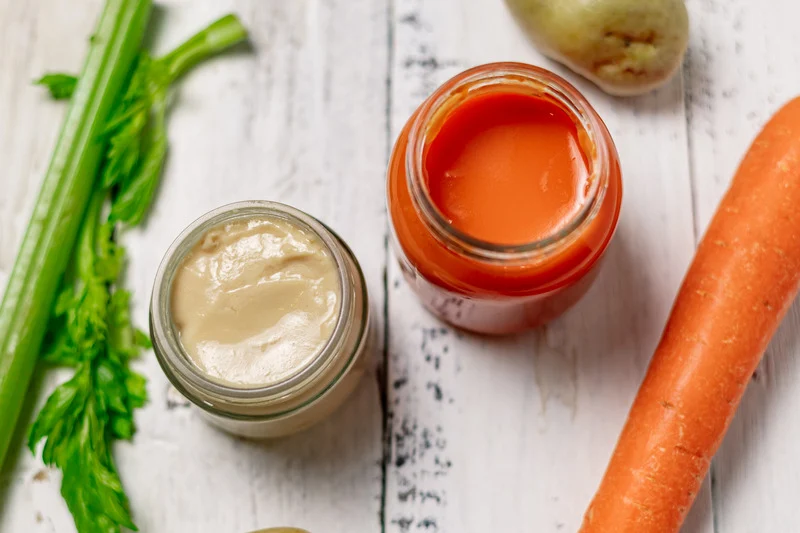
Jars of baby food:
- Babies can and should eat purees, however, this is definitely NOT the only texture you want to provide.
- The taste of a pureed food and the whole food form is very different.
- Mixed baby food flavors remove the taste of each individual food, which is important for palate development.
Alternatives: Unsweetened applesauce, yogurt, hummus, pureed soups (e.g. butternut squash, split pea), mashed potatoes; or homemade alternatives to store-bought baby foods.
Sippy Cups, Pouches, and Puffs are some of the other items that made it onto this “do not need” list. I go into a lot more detail on why and provide a list of alternatives in my eBook. Be sure to subscribe to our email list and get notified when it will be available!
How to Start Solid Foods Without Baby Food
You may be thinking – “If I am not going to feed my baby, who will?”
The answer is – your baby will! Yes, a baby who is ready to start solid foods, around 6 months of age, can and should feed him/herself.
Now, when I say your baby should be feeding herself, you are thinking I am crazy.
YES, It will be a learning process.
And YES, it will be messy. But, rest assured, your baby can feed herself.
When I say real food. I am not saying serve your 6 month old a cheeseburger and fries. We have to be intentional about the type of food and its texture to make sure it is safe and appropriate for your baby to consume. But, many whole foods can be made safe for 6-12 month old babies to consume by peeling, cooking, mashing, or even just cutting appropriately.
Additionally, unlike “Traditional Spoon Feeding”, you are offering your baby:
- A new food nearly everyday
- Alternating each food group (e.g. fruit, vegetable, protein, carb)
- More exposure to many different colors, shapes, textures, and tastes.
This wide variety will help them develop a more versatile palate and aims to prevent picky eating.
Want to Learn More
If you want to learn more, I have a free 5 day email course that goes in-depth on starting solid foods with infants.
Also, watch out for my eBook when it is officially published. It walks you through, step by step, on how to help your baby start off on the right path to becoming a very successful eater.
References:
Addendum guidelines for the prevention of peanut allergy in the United States: Report of the National Institute of Allergy and Infectious Diseases–sponsored expert panel
Togias, Alkis et al.
Journal of Allergy and Clinical Immunology, Volume 139, Issue 1, 29 – 44
Starting Solid Foods eBook. Three Roads Therapy LLC. Publication pending.
Photo taken from Canva and not an original image from Three Roads Therapy LLC.
Information Disclaimer:
The content, images, materials, and information provided on this website is only intended to be general summary information to the public. It is not intended to take the place of either the written law or regulations. It should not be viewed as medical, financial, legal, or professional advice of any sort. We will do our best to confirm the accuracy of all information that appears on our website but cannot guarantee accuracy, reliability, or timeliness. All recommendations are made without guarantee or warranty. We make no representations or warranties of any kind, express or implied, about the completeness, accuracy, reliability, suitability or availability with respect to the website or the information, products, services, or related graphics contained on the website for any purpose. Any reliance you place on such information is therefore strictly at your own risk.
We cannot predict and do not guarantee that you will attain a particular result from the information provided in or through this website, and you accept and understand that results differ for each individual. Each individual’s results depend on his or her unique background, traits, dedication, desire, motivation, resources, actions, and many other factors. You fully agree that there are no guarantees as to the specific outcome or results that you can expect from using the information you receive on or through this website.