
You’re preparing to start solid food with your infant, and you are wondering… “what do we need?” You search the internet and come up with a HUGE list. You are not sure which items are necessary and which ones are not.
This post may contain affiliate links. Please read our full affiliate disclosure statement.
Hi, Chelsea here! I am a pediatric speech-language pathologist (fancy name for a speech therapist) and feeding therapist. My most favorite thing to do in feeding therapy is work with infants who are learning to eat solid food. I also love educating parents on tips and tricks to help prevent picky eating. Your child does NOT have to live on mac n cheese and chicken nuggets!
This content about starting solid foods is mostly taken from my eBook. To get the full scoop on preventing picky eating, be sure to check out the ebook on our Teachers Pay Teachers Store!
Below, I’ve created a list of some important items to have. I have a lot of favorite items and some I have tried that I did not love. I have also listed brands or products that I know others have had success with.
Starting Solid Food
First, let’s review a few key points that we advocate for when starting solid foods. For more in-depth information, read Why Infants Don’t Need Baby Food When Starting Solid Food and Help! My Baby Doesn’t Like Solid Food.
If you have already read the two posts above, you know that we want to see babies start solid foods close to the 6 month mark, but more importantly, they need to have signs of readiness to start solid foods.
We want babies to feed themselves from the very beginning, hence why the gear listed below is so important. It has to match their skill and development level!
We want you to feed your baby real food rather than store bought baby food. But, that does not mean giving your 6 month old a burger and fries. Rather, it means intentionally preparing safe foods for babies to eat and develop mature palates that prefer real food over processed foods.
We encourage you to eat as a family and enjoy meal times together.
Feeding Gear Recommendations
Bibs
Not all bibs are created equally! I have tried different ones and have used different bibs at different times in my children’ s development. It is hard to say what will work best for your child, and it may be helpful to have a few different ones on hand.
Pelican Bibs
- I love these because they are easy to clean, they collect the mess, and allow baby to keep eating what has dropped
- Some things I do not like about them is that they’re heavy, so they did not work well early on for us. They are bulky and can limit vision and movement for littler bodies. They can also get stuck in certain trays.
Long Sleeve Bibs
- These are great for eating out or at others’ houses because they keep baby mostly clean.
- They do prevent the full sensory experience of food getting on more than just the hands and I do not recommend these for all the time eating. They can also be tricky to clean.
High Chairs
Good high chairs are definitely an investment. I highly recommend researching options and finding one that will best fit your needs and your home.
The most important thing about a high chair is the support it provides. We want baby to easily achieve a 90/90/90 degree position with the ankles, knees, and hips. It is crucial for baby to be sitting upright, in a well-supported trunk position and to have feet resting flat on a solid surface for safe eating.
High chairs should be easily adjustable to achieve the 90/90/90 position. If you already have a high chair or cannot or do not want to invest in the more expensive options, cheaper options can definitely be adapted to meet your baby’s position needs. We did not even have a fancy feeding chair in the outpatient setting I previously worked in. I used the seats we had and made a lot of adaptations as needed!
You also want to ensure your high chair has been tip tested and meets other necessary safety standards.
Abii Beyond
- This is the brand we have, and we love it overall. It is very sturdy and adjustable to grow with my children through their childhood years. I have had to exchange a piece of it, and the customer service was excellent and quick.
- Some downfalls include the cost, it is not easily portable, and it can be difficult to clean.
Stokke
- This is a highly rated high chair from both parents and pediatric feeding specialists. It supports adequate positioning and is easily adjustable.
- The downfall is the cost. It is quite expensive.
Portable or Collapsible
There are a ton of different brands of portable/collapsible/space saver chairs. These are great options, with proper adjustments. I use these as a therapist, with towel rolls to support sitting and/or placing them on a surface to allow for planted feet. We have one that we take with us to family events that is height-adjustable to allow for planted feet.
Utensils
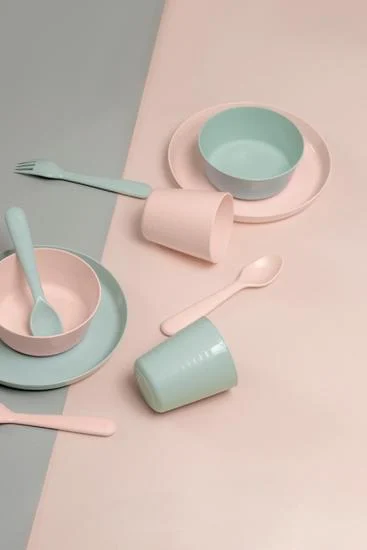
Utensil size and shape are very important for self-feeding. Babies should not be given long-handled utensils, as this can cause injury when self-feeding. Additionally, spoons with large bowls can present an issue with bite size and baby’s ability to clear the spoon bowl. Aim for short length, large-handled, and a small bowl at the end for spoons. Suction bowls and plates help decrease messes and offer baby an edge to help learn scooping skills.
- EZPZ spoons- there are also similar styles in different brands.
- Munchkin silicone.
- Bumkins.
- Munchkin spoon & fork set. I use these for older kids (10-12+ months), with supervision because they are metal.
- EZPZ suction plates and bowls.
- Abii Beyond suction plates & bowls. Links:
Cups
Babies should start learning to use open and straw cups around the same time they start eating solid food (e.g. around 6 months). It is important to have small, hand-held cups, to help baby learn to safely control an open cup and promote successful intake. There are also different straw cups listed below.
You definitely don’t need ALL of the things listed below to help your baby learn to drink! I just like to list several options with the pros and cons I have found with each so you have some ideas and can find what works best for you and your baby.
EZPZ Tiny & Mini cup
highly recommended among the feeding professional world. The shapes and sizes are perfect for little hands and little mouths learning to drink from an open cup.
Dixie Cups
I love using these for teaching open cup drinking. I always had them in my diaper bag in case we were out to eat or at a family event. They are easily available and very cheap. The downfall is that they smash easily and curious infants can find this quite fun!
Nosey Cup or Cut Out Cup
These are good for teaching open cup drinking and the feeder can really help control the flow. Some downfalls include the rough edges of the cup can cause some discomfort and they’re only available online.
Honey Bear Straw Cup
This is a great cup to teach straw drinking with because the feeder can control the flow of it. The downfall is that it’s not readily available at chain stores.
Take n’ Toss Straw Cup
This is seriously my favorite straw cup and I always recommend it! Such a simple cup, readily available, and very affordable. I like the straight, hard straw because you can easily remove it to teach straw drinking. *Use caution with the hard straw, and do not leave baby unattended with it*. It is also not a no spill option and will definitely make a big mess if it hits the floor!
Munchkin Weighted Straw Cup
I wait on this one until I have a proficient straw drinker. It is a mostly non-spill cup and a great option for on-the-go.
Mess Reduction
The mess is real, and it is a real concern for most, if not all parents. Some parents interpret the messiness as their baby not ‘liking’ the food, but this is not true. Read more about that here: Help! My Baby Doesn’t Like Solid Food.
Recognizing the mess as part of the process, and embracing it with this mindset will help! There are ways to help contain and reduce the mess.
I recommend covering the floor around where baby will eat, covering baby with a good bib and/or using “eating outfits” that can be changed and washed to prevent ruining nice clothes. There are also attachments that will keep utensils on the high chair tray so you’re not picking them up every 2 seconds. Below are some products that you can use to make life a little easier:
- Sheets, towels, or other drop cloths
- Silicone utensil attachments.
- “Eating outfits” – old or already stained outfits that can easily be changed and washed
So what about feeding baby in just a diaper?
I get this question a lot! While this is definitely a justifiable idea, I recommend keeping this to a minimum for a few reasons.
- We change the sensory experience when food goes from getting on our hands and face to getting on our whole bodies. This may make them more uncomfortable interacting with the foods.
- Most babies have a lot of rolls… when the food gets in all the rolls it can actually be more difficult to get baby clean than just removing an outfit and cleaning up the exposed skin.
While these things can definitely help, recognizing that this is going to be a messy process before you start can help you prepare! Also, recognizing why its messy – your baby is learning so much – can help alleviate some of the stress. Remember, this won’t last forever and you will reap the reward of having an independent eater. If you want to learn more about the importance of letting your baby self-feed, check out Why Infants Don’t Need Baby Food When Starting Solid Food.
Want to learn more about starting solid food?
Also, my ebook is now available, and it walks you through, step by step, on how to help your baby start off on the right path to becoming a very successful eater.
References:
Photo and Pintrest images used from Canva and not original to Three Roads Therapy LLC.
Information Disclaimer
The content, images, materials, and information provided on this website is only intended to be general summary information to the public. It is not intended to take the place of either the written law or regulations. It should not be viewed as medical, financial, legal, or professional advice of any sort. We will do our best to confirm the accuracy of all information that appears on our website but cannot guarantee accuracy, reliability, or timeliness. All recommendations are made without guarantee or warranty. We make no representations or warranties of any kind, express or implied, about the completeness, accuracy, reliability, suitability or availability with respect to the website or the information, products, services, or related graphics contained on the website for any purpose. Any reliance you place on such information is therefore strictly at your own risk.
We cannot predict and do not guarantee that you will attain a particular result from the information provided in or through this website, and you accept and understand that results differ for each individual. Each individual’s results depend on his or her unique background, traits, dedication, desire, motivation, resources, actions, and many other factors. You fully agree that there are no guarantees as to the specific outcome or results that you can expect from using the information you receive on or through this website.