
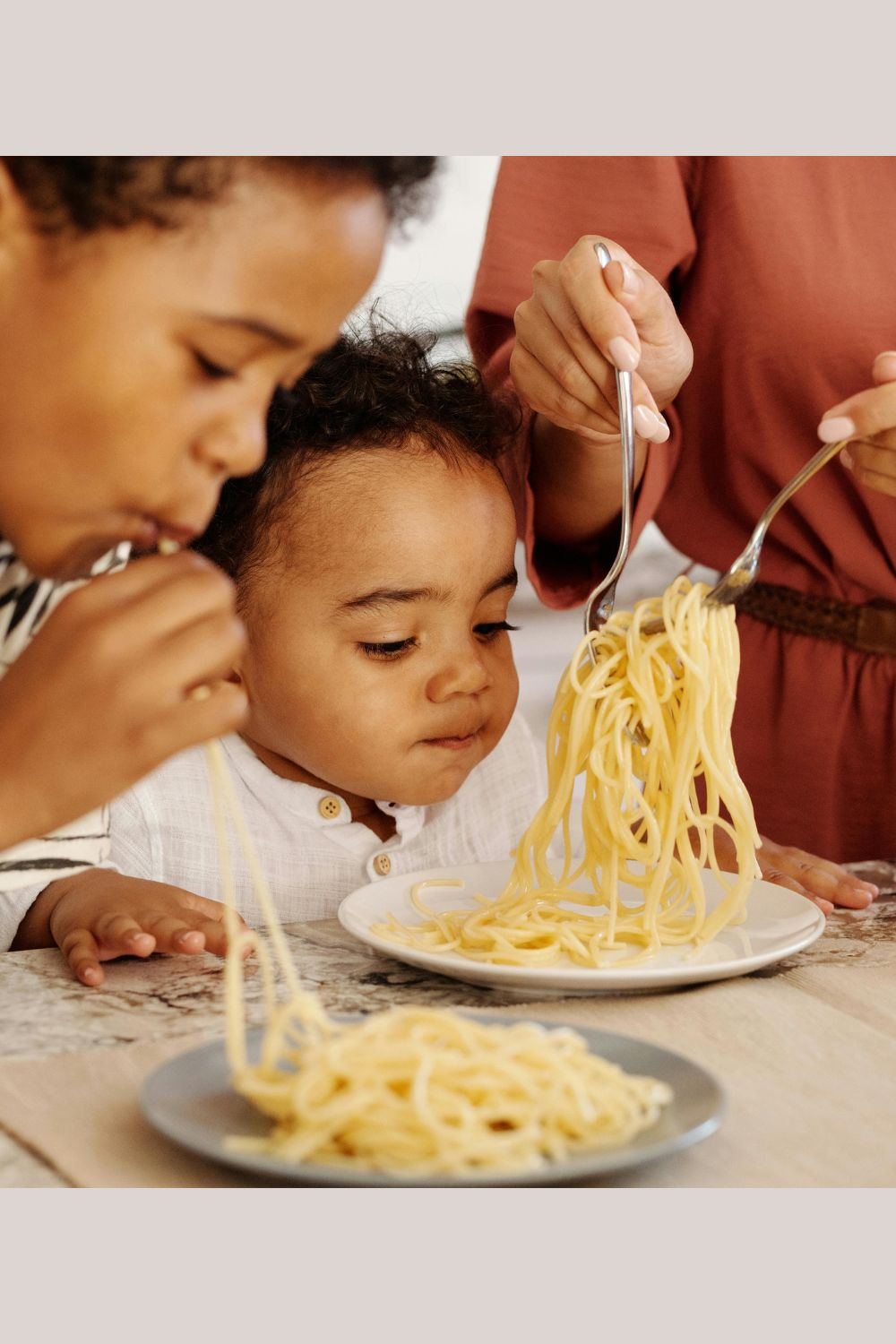
Picture this … you spend time making a wonderful dinner for your family. You call everyone to the table. Your 3 year old screams and runs away. After a fight, they come to the table. As soon as they see their plate they throw it onto the floor, refusing to eat. They drink their milk cup for their dinner and demand to get down from their chair after just a few minutes.
Or, you are making dinner … chicken nuggets (the dino ones only) and Kraft Mac N Cheese for your 6 year old; chicken nuggets, tater tots (because they won’t eat the Mac N Cheese), and an applesauce cup for your 4 year old; and since you don’t have the energy to make anything different for yourself and your spouse, you go with a combination of what the kids ate.
Or, your child eats the same 7-10 foods each week. They get sick and now are refusing to eat 3 of them. Now, they only eat 4-7 foods each week. They go for their well check and the doctor checks their iron level – severely low. The doctor recommends a supplement and to increase iron-rich foods. But the latter part is quite difficult considering your child will not try anything new, despite your efforts. You feel scared for what will happen to your child and their development with such lacking nutrition.
These are just 3 (of the many) examples I could give to paint the picture of “picky eating” in childhood. For clarity – I will refer to “picky eating” in this series as the term to describe anyone who struggles to eat a balanced diet or try new foods. There are different terms that could be used and further defined, but for ease I will use this term, as most parents can relate to “picky eating”.
These scenarios show different ends of the picky eating “spectrum” and most children fall somewhere in between. But, the struggles and frustrations are evident for parents regardless. AND your child’s development is lacking because of nutritional gaps when their diet is not well rounded.
Hi, I am Chelsea. Pediatric speech-language pathologist and feeding therapist since 2015. I have worked alongside many families with picky eaters and I see the struggle that it causes in families. In this two-part series, I am here to give you some insight on preventing picky eating (as much as possible) as well as provide some actionable steps into your daily routines to ease the burden of picky eating.
What is Picky Eating?
According to Kay Toomey, a pediatric psychologist and feeding expert, there are 8 characteristics of picky eating:
- Strong preferences
- Limited variety
- A restricted number of foods they will eat
- Avoiding new foods
- Refusing the “right” foods or the “right” amounts
- Getting more upset than peers
- Requiring a special meal by their parents
- May eat differently in different contexts
Why Are Kids Picky
There are a number of reasons why children become picky eaters. Many are not preventable, however, there are a number of things you can do from the very beginning to support your child’s eating. We will get more into that later. But, below are a few possible reasons your child may be picky. This is not an exhaustive list, but it will give you an idea.
Developmental
First and foremost, it is important to understand child development. I stress this all the time. Pretty much every parent who verbalizes frustration to me as a therapist, needs some education on what is normal child development. I also know that I am that “annoying” person/therapist who validates a lot of what children do and chalk it up to development.
Now, does that mean it is OK for them to do all of the said offenses? No. But when we understand why we can be less frustrated with them. When we are less frustrated and more regulated, we can help them rather than punish them for something that is developmentally appropriate.
Our job as adults is to teach them. I will say that until the end of time. But please, hear me out on this. We, as adults, are teaching children everything. From what they observe us doing to what they hear us saying to how we correct them. It is all teaching.
I got a little off track there, so let’s get back to eating and development …
Children are mostly self-centered. They think first about themselves … what they like and dislike, what they want and don’t want, and when their preferences are not met accordingly, they are learning how to accurately communicate that.
The fact that they are self-centered is because their brains are learning how to process their external and internal environments. That is, the things that go on outside of themselves (e.g. sibling takes a toy or mom serves food that is yucky), a.k.a the things they cannot control. And the things that go on inside themselves (e.g. they feel like they are going to explode or don’t like to look at a certain food), a.k.a the things they have some control over. There are so many things going on inside their bodies that they have to learn to tend to, or not, and then there are even more things going on outside their bodies that they have to learn to tend to, or not. And when all of these things come together, it can feel overwhelming. I feel overwhelmed just reading this paragraph!!!
So now, they have all of these stimuli to process and they don’t have much of a way to express it (e.g. they are still developing language and vocabulary). End result? They use what they have – their bodies- to meet their needs. They yell, they throw, they hit, they run, they refuse. Why? Not because they have bad behavior, but because they have so much going on in and around themselves, that they cannot focus on anything else BUT themselves. Hence my term… at the beginning of this section… self-centered.
I could probably go into more specific detail about brain and communication development, and how those things also play into picky eating, but I think I provided enough detail in my scenario above that you can understand my point. Their brains are still developing, and they do so with our guidance and teaching; and their communication skills are still developing to be able to communicate their desires and preferences.
Caloric Needs
Children have different caloric intake needs at different developmental ages and stages. Therefore, if a child is at a stage when their caloric needs are lower, they may not eat as much. When they go through periods of growth, their caloric needs may increase, and therefore they eat more.
If you have a toddler at home, you may notice this. They may “survive on air”, as my pediatrician says, for a few days, and then eat all the calories they did not consume those days in one or two meals!
When children go through phases of less caloric needs, you may see increased rigidity in what they will eat. So not only are they eating less quantity, they are also eating less variety. They may reduce the number of foods they eat and may have a preference for sameness in the specific foods.
It is very normal for children to restrict many foods that were previously in their diet when they go through a period of cognitive growth around 18 months. I usually refer to this as the “pre terrible twos”.
When we think “terrible twos”, what we are referring to is cognitive growth that has made the child understand cause and effect. And, they have learned that they can manipulate their environment by communicating (either verbally or nonverbally). These understandings cause them to experiment with control – what can they control? One thing they can control is what goes into their mouths.
This is generally just a phase, however, how we, as the adults in their lives, respond to them during this period will set the stage for how they come out of this stage.
I describe the 6-12 month phase (e.g. weaning phase) as the most important for variety and palate development. But I describe the 1-3 year old phase (e.g. toddler phase) as the most important for learning the rules of eating.
What you teach and shape into a routine during this phase will be what you reap into later toddlerhood and into early childhood as far as eating patterns.
So, I always congratulate parents when they “make it” to 12 months with their infant. The messes, the potential allergies, the messes, the constant checking for safety, the messes.
But, I also encourage them to not let up in terms of their diligence with continuing to form healthy boundaries and patterns for their child’s eating.
Sensory Challenges
I talk a lot about sensory challenges in my blog posts on behavior (part 1) and (part 2). This is because the state of our sensory system drives a lot of what we do.
If you are not overly familiar with the sensory system, I will give you a quick run down.
Most of us think of the 5 “typical” senses: hearing, vision, taste, touch, and smell. There are now many more recognized sensory systems, including proprioception, kinesthetic, vestibular, and interoception.
The 5 originally recognized senses take in all of the information from the outside world. The additional senses are internal senses that make sense of what is going on inside our bodies as it relates to the outside world.
To make this a little more understandable, think of the last time you were hungry. Like, really hungry. And someone cut in line in front of you or asked you a difficult question.
How did you respond?
Chances are your response to the difficult question may have been scattered or shallow in detail.
Why?
Because you were dysregulated. You might have been fidgety, irritable, or distracted, to name a few.
To apply this to children and their eating preferences …
Children are learning to regulate their sensory systems. If they have any neurodivergence, it is likely they are experiencing even more challenges with sensory regulation. Therefore, when they are presented with a task during a time of dysregulation, it is likely they will have a negative response to it.
Eating is a sensory experience – we see the food, smell it, feel it, hear it, and taste it. While sitting in our chair, we can either feel grounded or unstable (proprioceptive). We interact with the food using movements in space, either successfully or unsuccessfully (kinesthetic). And, the way the food makes us feel – satisfied, full, sick – will reinforce the future desire or avoidance of that food (interoception).
Oral Motor Difficulties
Oral motor = oral strength and movement.
So many people do not think about eating (or talking) as muscle movements … they are just things we do! But, I spent a lot of time memorizing all the muscles involved in moving the lips, tongue, jaw, throat, and more. And let me tell you, there are a lot of them!
Children must develop appropriate oral strength and function in order to appropriately chew and swallow a variety of textures. When their oral structures are weak or they do not move efficiently and effectively, they will compensate.
Compensation may look like subtle oral habits – that maybe only a trained eye would see. Or, they may look like food selectivity – that parents and caregivers will definitely see.
However, it is also important to note that this is also a “chicken or the egg” conversation. Therapists often question whether the weakness was the underlying issue which caused the child to avoid more difficult textures in order to compensate for the weakness. Or, is it because the child never had the experience with more difficult textures, and therefore, they did not fully develop appropriate strength and range of motion.
Regardless, without one they cannot have the other. Without strength, they cannot eat more difficult textures. Without exposure to more difficult textures, they cannot have strength.
How Common is Picky Eating
Some studies have shown that pickiness peaks around 3-4 years of age, where again, we see huge changes in cognitive development.
Research numbers are fairly inconsistent in terms of how frequently children are picky eaters, but the numbers seemed to range from 20-50% depending on the age in which they were measured.
As I reviewed the research, one thing was clear. The earlier the onset of pickiness, the longer it lasts. Therefore, if you have concerns early on, it is best to address them early on. And by address I do not mean forcing or bribing your child to eat, because these things will just set their progress back even further. So please, if you have concerns with your child’s eating, take this information and seek a medical professional as soon as possible.
Final Notes
Now that we have a basic understanding of picky eating and why it happens, be sure to check out my next posts in this series with some ideas on how to address picky eating in your home.
References:
Romeo, C. (2023). Just a Phase or Cause for Greater Concern. Citing Kay Toomey’s Presentation with Feeding Matters. Obtained from: https://www.feedingmatters.org/picky-eating-just-a-phase-or-cause-for-greater-concern/
Picky eating in children: Causes and consequences. Proc Nutr Soc. 2018 Nov 5:1–9. doi: 10.1017/S0029665118002586. Retrieved from: https://pmc.ncbi.nlm.nih.gov/articles/PMC6398579/
Cover image and Pinterest images are not originals from Three Roads Therapy LLC. Obtained from Canva: Aflo from Aflo Images; Anastasia Shuraeva from Pexels; KATRIN BOLOVTSOVA from Pexels; Pavel Danilyuk from Pexels; Seahorse Photo in BKK; Emma Rahmani from corelens (2); Tetiana Nekrasova from capturenow
Information Disclaimer
The content, images, materials, and information provided on this website is only intended to be general summary information to the public. It is not intended to take the place of either the written law or regulations. It should not be viewed as medical, financial, legal, or professional advice of any sort. We will do our best to confirm the accuracy of all information that appears on our website but cannot guarantee accuracy, reliability, or timeliness. All recommendations are made without guarantee or warranty. We make no representations or warranties of any kind, express or implied, about the completeness, accuracy, reliability, suitability or availability with respect to the website or the information, products, services, or related graphics contained on the website for any purpose. Any reliance you place on such information is therefore strictly at your own risk.
We cannot predict and do not guarantee that you will attain a particular result from the information provided in or through this website, and you accept and understand that results differ for each individual. Each individual’s results depend on his or her unique background, traits, dedication, desire, motivation, resources, actions, and many other factors. You fully agree that there are no guarantees as to the specific outcome or results that you can expect from using the information you receive on or through this website.