
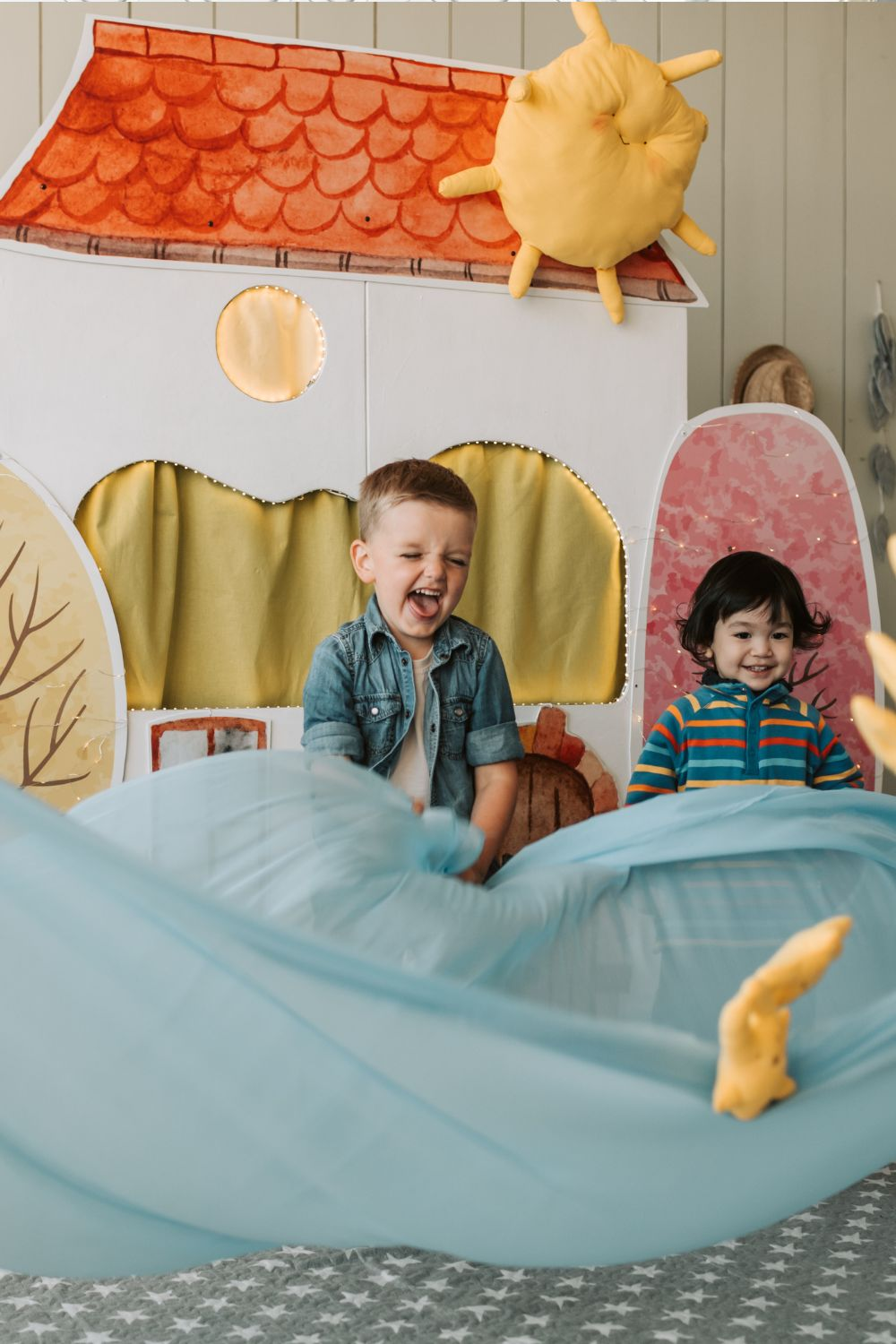
Play. The work of a child. This quote from Maria Montessori, has brought light to how important play is on childhood learning.
Three Roads Therapy LLC is an Amazon Affiliate. This post may contain Affiliate links. If you make a purchase from the links provided, we may earn a small commission, at no additional charge to you. Please read our full Affiliate Disclosure statement.
Hi, Chelsea here. I have been a pediatric speech-language pathologist (fancy name for a speech therapist) since 2015. Working with kids, I have learned to be a professional at playing. Play. Is. So. Important. And I love talking about why, here!
When I started to write this post, I thought about going into all the different types of play and how a child develops play skills. Then, I realized two things.
- There are already great milestone charts out there for play and
- Many caregivers are not all that interested in the exact milestones of play.
So instead of reinventing the wheel, I have attached some great play milestones at the bottom of this post for those who may be interested! These were not developed by Three Roads Therapy LLC.
Just Play…
I have always viewed myself as a “play-based” therapist because what I am doing looks like playing. And I would be happy to hear that a child thought “Miss Chelsea” just came to play today, because they didn’t realize they were working.
As a mom, I see the value of play firsthand. However, I can also see how it would be challenging to follow my speech therapist-self’s recommendations to “just get down and play with them”. It seems like such an easy recommendation to make as a therapist, who plays for a living. But in the context of real life, we are busy. And really, playing with my own children who I see all day long is way different than the children I only spend a short amount of time with each week.
Why is Play Important
Unlike adults, children don’t have jobs or specific responsibilities at a young age. Their job is to learn and develop. Therefore the saying “play is the work of a child” by Maria Montessori is true.
- Children learn best through play
- The activity that should keep them the most busy during the day is play
- Play allows for many opportunities to develop problem-solving, executive functioning, cognitive skills, receptive & expressive language, and fine & gross motor skills
All children, but especially those in the 0-5 population, should be primarily learning through play. The more hands on they can be during the day, the more they will strengthen all of the skills listed above.
When they are actively involved in their environment, they will need much less repetition of the skill than if they were passively absorbing it or even “learning” in a 2-dimensional manner.
What do I mean by passively absorbing
This refers to the “learning” that takes place without the child being actively engaged. An example is watching something. Children tend to “zone out” when presented with a screen because of the imbalance of visual stimulation as compared to other senses. They get tunnel vision and absorb what is on the screen.
While there are a lot of “higher quality” shows that aim to prevent this through engaging the child during the show, or through lower visual stimulation (e.g. slower frames), young children should have very limited exposure to screens. And we should not be relying on these as a means of our children learning. Children should be learning through play and interactions first and foremost. Be sure to watch for our upcoming post on screentime for more information!
What do I mean by 2-dimensional
As it sounds, 2-dimensional activities are those that do not involve manipulatives. A 2-dimensional worksheet or even a 2-dimensional screen would be examples of this. I will talk about the former, as I stepped off my soap box on the latter in my previous paragraph 😉
Worksheets have their place in education for older children, but for younger children, they should really be limited. I heard a statistic during a recent episode of the Christy Faith podcast, and while I am not quoting it exactly, the speaker said that children need something close to 20 times more exposures to a concept when they interact with it in a 2-dimensional way. Find the link to that podcast in the references section.
Structured Play vs Free Play
While I tend to encourage a lot of free play, free play doesn’t tend to happen on its own. For young children, you often need to set it up or even teach them how to play on their own.
As children get older, when they have been given the opportunity to play on their own, you should start to see longer and more expanded play “sequences”.
Structured Play
This is what I do when I come to someone’s house to see their child for therapy. I have specific toys or activities that I intend to use to teach or cue a certain target. These are usually referred to as adult-led activities.
This is when we have a pre-planned idea in our own heads that we want to teach the child. This may be how a specific toy works, how to build something, the rules of a game, or the correct placement of pieces on a puzzle.
Yes, all of these skills are important, however, doing it correctly is NOT always the goal. We can absolutely model how to play with toys, but asking the child to copy our own play or “do it correctly” is squashing their natural creativity, problem solving, and perseverance.
Instead, we recommend more of a child-led approach to playing with your child. Many people hear “child-led” and are immediately turned off to the idea. They think this means the child can do whatever they want without limitations, rules, or regard for others. What this actually means is:
- Children have the freedom to choose what they want to play with
- Children have the freedom to experiment with a toy *safely*
- Children have the freedom to play incorrectly
- Children have the freedom to play for as long as they want, transition activities, or combine multiple toys in play, to help develop their attention span
You are still welcome to have rules and boundaries with toys, safety, and respect for others during play. But, allowing the child to direct the play and involve you (the adult) as a playmate and model for new things, not the director, will help them more than being told what to do and how to play.
When we tell children how to play, rather than just model different play schemes, we remove their ability to play creatively and freely. Repeatedly told how to play, they become reliant on cueing and cannot develop the skill of independent play.
Free Play
As I described above, we want children to learn to play freely. With our engagement in play, we can model how to play with different toys in different ways and we can also follow their lead to play with them.
As they learn to play with a variety of toys, we can start to encourage them to play on their own and develop creativity and an attention span, while engaging in problem solving activities.
What this might look like:
- For infants, put them under a play gym while you sit nearby and do a task of your own. You may intermittently help them if they get stuck in a position or comment on their activity, but otherwise encourage them to play while they are content.
- For young toddlers, get out stackable tupperware, lids, and basic utensils while you do dishes. They are close (and supervised) but entertaining themselves and learning basic stacking and sorting skills.
- For older toddlers, give them craft supplies or even Play Doh (based on safety of use/item) while they sit in their high chair after a meal and you clean up the meal and mess. Because the clean up will be messy with this age of child! Learn more about that *here*
- For preschoolers, ask them to play in their room (or designated space) during “quiet time”. Ensure they have a few different toys that are safe to play with unsupervised.
What this might also look like:
- Infant cries as soon as you put them down
- Toddler runs away and climbs on something (unsafely) 5x
- Toddler throws all the craft supplies down and asks to get out
- Preschooler wants you to come play too
While the first scenario sounds like the ideal situation, the second scenario is pretty likely, and a combination of the two is definitely going to happen at some point. What we need to remember is that they are children and they are learning. It is our job, as professionals and caregivers, to teach them. They will not do it perfectly the 1st time or even the 1,000th time, and perfect is NOT the goal.
The goal is for them to learn. The goal is for us to see progress over time, not a “quick fix”. We have to go the distance and endure the repeated need for correction. When we consistently meet them with curiosity – trying to understand where the breakdown is – and help them to correct it, we will reap the benefit in the end. That might not mean it went peacefully today and it might not tomorrow either, but they will get there.
When the learning is frustrating
When I meet frustrated parents, one of the things I point out is how many times it took them to consistently do something new… maybe this is taking time to read each day, or working out a few times a week, or learning to bake bread. Often, parents say they did it really well a few times then forgot, or got busy, or couldn’t quite get it right. After this response, I gently remind them they have had a lot more years on the planet and are still struggling through something new. If we, as adults, still don’t always get it right, why are we expecting children to get it right every time?
The more we balance playing with our children, the more they will learn to play on their own. If there is a fairly consistent routine in your day, they will know the times of day that they are expected to play on their own and when they will be together with you. This will make them less likely to seek you during free play, because they know in a few minutes, they will get some time with you. Or, they have just had their morning snack and book time, so their bellies (and their figurative) cups are full, so they are ready to sit and build something amazing with their blocks.
I will touch on another tip for encouraging free play next!
Toy Rotation
I could probably write an entire blog post on this topic! I have always used toy rotation in therapy and have also carried it out into my own home. Seriously. Amazing.
What is toy rotation?
This is where you put out a few different toys and store the rest away. Every 1-4 weeks (depending on the toys you have out, your kids, etc), you rotate the toys with others you have stored away. When you get out the “new” old toys, children are so excited to play with something fresh. It feels like Christmas!
What to rotate?
In my home, I always have at least:
- 1 puzzle
- 1 fine motor manipulative (e.g. Potato Head, Flower Garden)
- 1 creative toy (e.g. musical instruments, building set)
- 1 pretend play (e.g. farm animals, kitchen, cash register)
- 1 specific toy that each of my children loves (e.g. vehicles, babies)
Yes, you’ve read that correctly, we might only have a total of 5-7 toys out at a time.
Don’t your kids get bored? Yes, they do. And guess what? They often learn to play with the toys that are out in different ways. *or annoy each other and then I have to redirect*
Don’t you have any electronic toys? Sometimes, but rarely. If the toys are talking, why would my child need to talk? If the toy has 4 pre-stored messages, that limits the play/learning to those 4 things. Electronic toys, similarly to screens, create tunnel vision, because they are heavy on the visual and auditory stimuli (e.g. blinking lights & music). This removes a child’s creativity in their play. If we want play to be work, we have to allow their brain to actually work, not zone.
If we have an electronic toy out, we have 1, not multiples, to reduce the stimulation. It also tends to get rotated a bit quicker than some of the other toys.
More things to rotate
We also have a designated craft area that gets rotated about 1x/month. My preschool aged child has been using craft supplies since a very young age, with help. And now, this child is mostly independent and trustworthy with them. My toddler is learning, but cannot have “free range” to the craft supplies just yet. So, the craft area is currently our kitchen table. I keep 1-2 small baskets of items for the preschooler to use at any time and the toddler, upon request or with assistance.
The basket always includes paper, safety scissors, tape, glue sticks, stapler, and a few writing utensils. I rotate things like sticker books, sticky notes, scratch paper, markers, colored pencils, fancy tape or scissors, paint, Play-Doh + utensils, beads, fuzzy sticks, poms, etc.
We rotate our books as well. Instead of having a large bookshelf with all of our books out, we keep a basket that holds 25-35 books. We rotate these with themed books, long story books, kids bibles, board books, manipulative books, and library books that we check out about once a month.
Now, you are likely reading this and thinking… “who has time to rotate all these things?” And while I hear you. Some days I have to take a deep breath (or 5) before I rotate toys. I have learned a few things along the way:
- Keep everything organized so it is easy to pull out and rotate. Store toys in bins, use lids for easy stacking, labeled if you want, and try to keep 1 specific toy or toy category per bin so you don’t have to sort when you pull it out.
- Declutter trash, missing/broken pieces as you put them away. Your future self will thank you.
- Rotate 1 space at a time. Don’t feel the need to rotate books, craft supplies, and toys all in the same day. Do 1 each week to give yourself a break!
- You also don’t have to rotate every single toy. I often rotate 2-3 toys and keep a few out.
- Remember how I said the rotation will feel like Christmas for your kids? This is true. They will be so excited with the new toys, that they will likely sit and engage with them for quite some time. So, I actually try to time this on a day or time of day when I have a few things to get done. Rotate the toys. Let them play quietly for a while. Get a few tasks completed on my own.
Invitation to Play
I heard the idea of “invitation to play” a long time ago, and I am not even one hundred percent certain where I heard it, but it resonated with me. It goes along with one of my most favorite therapeutic strategies that I use often with children called communicative temptations, also known as sabotage. I talked about this in my Waiting for Successful Language Development post last week.
Basically, we are tempting children to want to play. In therapy, I would use some of the specific communicative temptations from Barry Prizant (reference below), such as storing toys in a clear, but closed container or giving the child 1 piece of a preferred snack rather than a whole bowlful.
These are surefire ways to get a child to initiate and use language!!!! But, they are also surefire ways to see “behaviors” (an upcoming blog series that I am really excited about). AND surefire ways for parents to think I am a mean therapist.
What I always explain when I do these things is that when we use something that is motivating, a desired toy or preferred snack, the child wants it. When they want something, they have a need to communicate that. Even “behaviors” are forms of communication *spoiler alert for the behavior series*. But, this is a very effective way to build communication skills.
Alternatively, when we set up an invitation to play, we are putting out something novel or motivating and encouraging free play with said item(s). Some ways to do this:
- Morning (or other time of day) baskets. Marla, at Because I Said So Baby, talks a lot about Morning Baskets. She has tons of ideas, themes, and shopping links! Check her out: https://www.becauseisaidsobaby.com/
- Complete your toy rotation while your children sleep, so they wake up to new toys in the morning
- Present a known activity in a new way. I recently put our sensory bin in our water table since it is winter and the water table is not in use. This larger space makes it easier to play longer and the children are amazed the water table is inside! I share this, and other ideas, in our Valentine’s Day Activity Pack.
- Build a giant tower or extravagant building with magnetiles or blocks while your children nap, so they wake up to some inspiration.
- Set out a bunch of new craft supplies in a topping organizer or muffin pan.
- Set up 2-3 stations with activities, such as a play kitchen, cash register and/or dolls to encourage a full sequence of activities to transpire between the items to purchase and prepare the food for their friends.
All of these activities require some planning. And I would say out of everything, this is where parents have the greatest breakdown. We get it. That is why we are here – we have heard many, many, many struggles and just about as many successes from parents, just like you.
Some tips:
- Keep your toys/supplies organized, in bins with lids, labeled if that works for you. This makes it easy to pull and grab the things you want to prep and put out.
- Start with 1 thing from the list above. Plan out several days or weeks worth of this activity and write down your plans + supplies. When you “batch” prepare, you don’t have to think about what you are doing each time, because you already have a plan.
- Use times when your child is sleeping (or outside with grandma) to get the activity set up so it is a surprise.
- Repeat the same activities, with different themes to prevent the need for planning multiple different activities. Rather, you can purchase/prep different specific manipulatives within the same activity. For example, I use a sensory bin for almost every holiday. I just alternate the filler (e.g. rice, beans, lentils) and the manipulatives (e.g. pumpkins, pine cones, hearts).
Toy Recommendations
There are SO many toys out there that parents often feel the need to buy all of them in order to keep their children engaged. Focusing on toy quality rather than toy quantity is a great place to start. When selecting toys, I recommend:
- Open ended
- Minimally or non-electronic
- Toys that span age ranges
We have created a list of some of our favorite toys
Pretend Play:
- Melissa and Doug Vet Kit: https://amzn.to/4k2y78j
- Peek A Boo Farm: https://amzn.to/49LtMBm
- Ice Cream Play Set: https://amzn.to/49EI7Rt
Problem-Solving:
- Melissa and Doug Magnetic Bug Puzzle: https://amzn.to/4jX4G7z
- Magnetic Bird Feeding Game: https://amzn.to/460rPQy
- Cutting Food: https://amzn.to/4k6PEMj
Open Ended:
- Magnetiles: https://amzn.to/4k1L1TK
- Flower Garden: https://amzn.to/4tbEeva
- Stacking Blocks: https://amzn.to/4k2CSOS
Learn More
There are a wealth of resources out there on play and why it is so important!! I have done countless professional trainings on this topic, and I learn something new each time.
I have also compiled a list of a few great books written on this topic for caregivers or therapists. There is also a list of Play Milestones, if you are wanting to learn more about what types of Play should be developing according to your child’s age.
Balanced and Barefoot: https://amzn.to/4qQnA2u
The Hurried Child: https://amzn.to/4qY7Qu8
Teach Me To Play With You: https://amzn.to/4qNgLih *this was designed to help children with identified delays*
Kathy Eggers Books on Play: A Summer of Playing Skillfully: https://amzn.to/4qWSRAP and A Year of Playing Skillfully: https://amzn.to/4k56lrz *these are more so designed as a home school curriculum*
Play Milestones
Here are some resources you can check out if you are interested in the developmental milestones for play.
https://pathways.org/kids-learn-play-6-stages-play-development
https://www.cdc.gov/act-early/milestones/index.html
References:
Homeschooling Preschool: How to Get the Most Out of the Early Years, (2025).The Christy-Faith Show. Guest Speaker: Kathy Eggers. Retrieved from: https://christy-faith.com/podcast/homeschooling-preschool-how-to-get-the-most-out-of-the-early-years/
Language Acquisition ebook. Three Roads Therapy LLC. Publication Pending.
Wetherby & Prizant (1989). Communicative Temptations. Retrieved from: https://nona-cdc.com/wp-content/uploads/2016/10/Communicative-Temptations.pdf
Blog Image: The image used on this blog was not an original from Three Roads Therapy LLC. Obtained from Canva: Vlada Karpovich from Pexels
Pinterest Images: All Pinterest images were obtained from Canva and were not original images from Three Roads Therapy LLC. Ian Taylor from Pexels; Vlada Karpovich from Pexels
Information Disclaimer
The content, images, materials, and information provided on this website is only intended to be general summary information to the public. It is not intended to take the place of either the written law or regulations. It should not be viewed as medical, financial, legal, or professional advice of any sort. We will do our best to confirm the accuracy of all information that appears on our website but cannot guarantee accuracy, reliability, or timeliness. All recommendations are made without guarantee or warranty. We make no representations or warranties of any kind, express or implied, about the completeness, accuracy, reliability, suitability or availability with respect to the website or the information, products, services, or related graphics contained on the website for any purpose. Any reliance you place on such information is therefore strictly at your own risk.
We cannot predict and do not guarantee that you will attain a particular result from the information provided in or through this website, and you accept and understand that results differ for each individual. Each individual’s results depend on his or her unique background, traits, dedication, desire, motivation, resources, actions, and many other factors. You fully agree that there are no guarantees as to the specific outcome or results that you can expect from using the information you receive on or through this website.